Mr. Amazing Meets Mr. Angst
Why Digital Transformation Depends on People

from Dr. Elena D’Cruz
23. July 2026
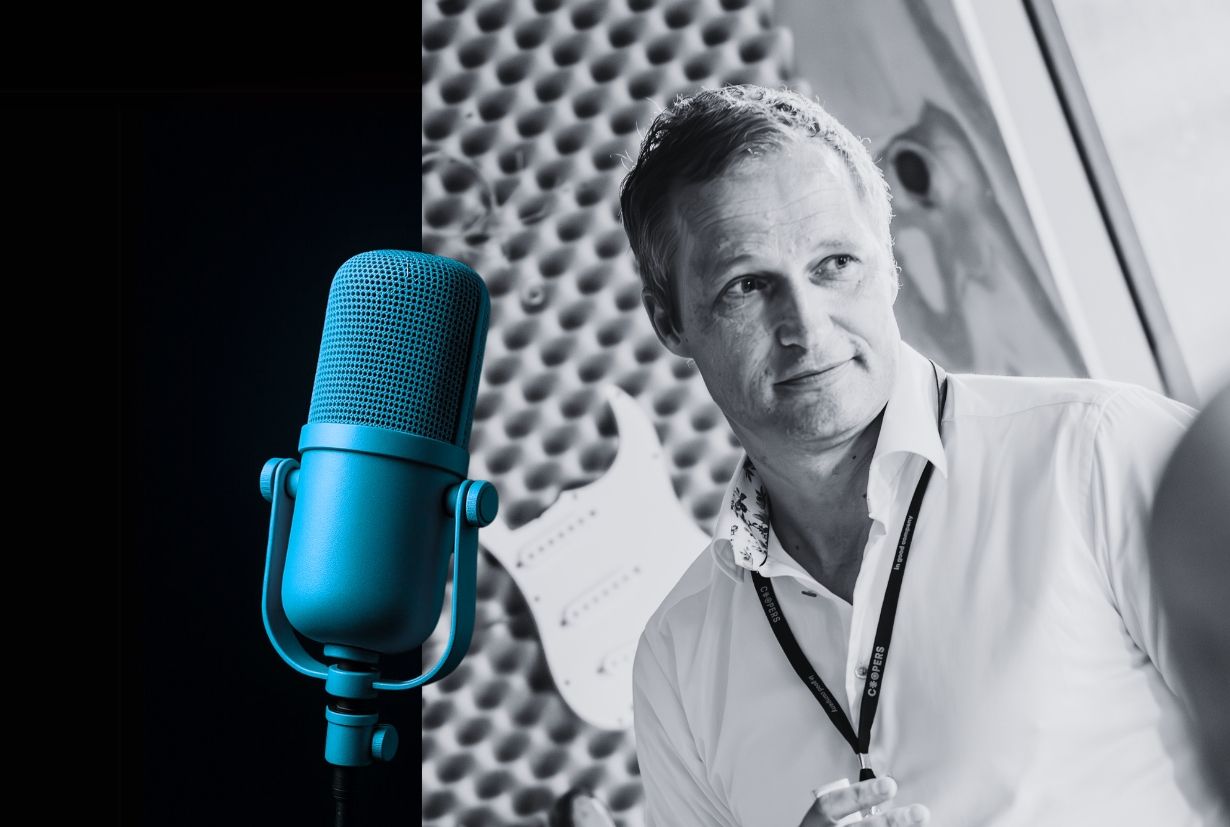
Digitalization rarely happens on an open stage. Oliver Kahle, Global Head of Procurement Excellence at Georg Fischer (GF Flow Solutions), made that clear right at the start of his talk at the Coopers Procurement Day: only 20% of a digital transformation is visible: technology, business cases, new tools. The remaining 80% happens beneath the surface: employee motivation, mindset, skills, and fear.
To dig deeper into the topic, we sat down with Oliver Kahle to talk about why transformation projects really fail, how generations can work together in the age of AI, and what all of this means for leadership in everyday life. Along the way, we met Mr. Amazing and Mr. Angst, and picked up plenty of insights.
Coopers: Oliver, you say digitalization does not fail because of technology, but because of people. How did you arrive at that conclusion?
Oliver Kahle (OK): When we talk about digitalization, we usually only see the tip of the iceberg: the technology, the business cases. But beneath the surface sits the employee, with all their feelings: involvement, understanding, mindset, skills, and for many, fear too. Hardly anyone admits it openly, but it is there. Feelings are the drivers of our actions: if you are afraid, you do not move. This has already been proven multiple times in neuroscience. And no movement is the worst thing a transformation can have. We see the same thing with generative AI: according to a recent MIT study, 95% of companies see no measurable return on their GenAI investments, despite billions spent. My thesis is: it is not the technology itself; it is that employees are not brought along.
Coopers: If fear plays such a big role, what can counter it? How do you build trust?
OK: The only way to counter employees' fear is to acknowledge it, take it seriously, and build trust. A good foundation for that is the Trust Triangle. It has three sides: 1) authenticity, 2) logic, and 3) empathy. With authenticity, I show up as who I am. Logic means explaining to my team why I want something, not just by when. And empathy matters because it lets us put ourselves in the other person's shoes. Employees can tell very precisely whether management means it or is just paying lip service. Try it yourself: think of someone you do not trust. I am certain one of these three components is missing.
These three components give rise to two kinds of trust: cognitive trust, meaning I trust your competence and reliability, and affective trust, which comes from the heart: I trust your intentions and your care for me. The second is much harder to build, but at least as important.
Coopers: So is trust a necessary but not sufficient condition for a successful transformation? You have also looked closely at the research on how often transformation projects actually fail.
OK: Exactly: without trust, nothing works, but trust alone does not guarantee success either. I looked closely at the numbers from Bain & Company and the Harvard Business Review, which cite failure rates of 80 to 90%. In reality, only about 12% of projects deliver what was originally planned, but that does not mean 88% fail outright, it means many land somewhere in the middle and have to course-correct along the way. There are three reasons for that: it takes longer than expected, so the deadline slips. As a consequence, it naturally gets more expensive, so the budget is exceeded. I can course-correct on both of those with time and money. The third reason, though, and for me the decisive one, I cannot fix that way: employees do not come along with the transformation. As the saying goes, you never get a second chance to make a first impression. If I explain a transformation poorly from the start, do not communicate enough, and do not bring the workforce along, I cannot make up for that later, no matter how much time or money I throw at it.
Coopers: How do you make sure you get that first impression right? In other words, how do you get employees on board from day one?
OK: A company usually changes for one of two reasons: Fighting the Dragon, meaning there is a threat, and if I do not move, I might not survive, or Winning the Princess, the positively charged version, where I am pursuing, say, technology leadership to differentiate myself from competitors. Tesla did a great job of this in technology leadership for a long time; Patagonia would be an example in sustainability. Those are motives for companies, but on their own, they are not why an individual employee changes. An employee only changes once they understand why they should. "Start with why," a principle made famous by Simon Sinek's Golden Circle. If I say, "we are rolling out a new system and you have to get on board," employees hear that, but they do not understand it. If I explain that the company has to stay competitive so their job stays secure, then they understand it. That is why the order matters: first the why, then the how, and then the what.
Coopers: Follow-up question: How do you make sure every employee gets through the transformation successfully and stays on board?
OK: I get asked this a lot, and unfortunately there is no simple answer. As a leader, I first have to clarify my own mandate and communicate it clearly. Is the mandate to future-proof the procurement organization, or to bring every single employee along on this journey and support them through it, including those with no interest in it at all? Or, to put it provocatively: I am not a public bus service. My mandate is not to take everyone with me. I take along those who want to move.
Coopers: Another important topic in transformations is collaboration between generations. You introduced two characters for this, Mr. Amazing and Mr. Angst. Can you tell us more about them?
OK: Gladly, those two are my favorite colleagues. Mr. Amazing is the digital native who asks Copilot, Perplexity, or ChatGPT before thinking for himself, and believes that already makes him smart. What he is missing: the network, the experience, the judgment, and the social skills to get his ideas adopted within the company. That is what Mr. Angst can do, the experienced colleague. Unfortunately, he does not even realize what knowledge and skills he has, because the fear of losing his job puts him into a "fight, flight, or freeze" mode, and he ends up thinking about everything except how he could support the transformation ahead of us. He is genuinely afraid, because he has just been told that a bot is taking over the task he has performed for years. If I do not tell him what happens to him afterward, he will not even set up the bot. That is simply human, pure survival behavior.
In this context, we can distinguish between three types of knowledge: documented knowledge, like writing meeting minutes, process steps, or presentation templates. These are tasks traditionally handled by junior employees under the guidance of senior colleagues, and now increasingly done by AI. Contextual knowledge, meaning how our organization-specific processes actually run in practice, where AI can mostly only assist. And implicit experiential knowledge, meaning judgment, timing, power dynamics, and networks, which I consider irreplaceable, because it is never documented anywhere and cannot be replicated by AI.
Here is my thought experiment: in the short term, it is tempting to stop hiring juniors altogether, since AI now handles these classic entry-level tasks. The problem is that juniors have always built their implicit experiential knowledge by doing exactly those tasks, knowledge that cannot be documented, only learned by doing. If we take those tasks away from them, they never gain that experience. And when the experienced generation retires in three to five years, our leadership pipeline will be empty, because nobody has grown into that knowledge. That is why we need to bring Mr. Amazing and Mr. Angst together today, before it is too late.
Coopers: What is the best way to go about that?
OK: This is where you have the chance to bring your workforce along and show them that they can learn and adapt. It comes down to mindset. Neuroscience has shown that we can learn new things well into old age, even after years without any further training. This is what is known as a growth mindset: I can change, I can learn something new. The opposite would be a fixed mindset: my talent and abilities are innate, and I cannot influence them. What matters is understanding that we always carry both mindsets within us, and apply them depending on the situation. Someone working as a safety officer at a nuclear plant does not need to try new approaches. They need to do their job reliably, which calls mainly for a fixed mindset. But someone who wants to introduce new digital tools or AI has to draw on their growth mindset, try things out, and change. In short, growth mindset means, for me: change is possible. That does not mean I automatically change, but it does mean our brain is fundamentally capable of it.
And when I change and learn something new, mistakes happen. That is a good thing: for me, mistakes are not a sign of weakness, they are fuel for innovation. Why it still hurts can be explained by neuroscience. Our brain is still shaped by prehistoric instincts: something new that we cannot yet do used to mean danger. Our brain experiences mistakes as physical pain. We push ourselves to avoid that pain in the future. We make small improvements, experience an initial win, and as a reaction to that sense of success, our body releases dopamine, our happiness hormone. Dopamine has the same effect as nicotine: it is mildly addictive, and we want more of it. And through this ongoing exchange of dopamine and other neurotransmitters, new knowledge is formed.
My tip: right in that phase, when it really hurts, we cannot stop. That is the tipping point, and we have to push through it. I always tell my team: our brain is a muscle. If I have not been on a treadmill in 20 years, the first two minutes will hurt like hell. But after that, it gets better. Once employees understand this mechanism, they stop saying "I cannot do this" and start saying "this is part of it, I am on the right track."
Coopers: That makes sense. Can you make it more tangible with a concrete example?
OK: Sure, happy to. Let us take the example of data analytics. A young colleague, let us call him Julian, can use this technology to identify more savings right away than his experienced colleague, let us call her Martina, working her usual way. Simply because Julian can now analyze huge amounts of raw data within seconds. Julian knows the tool inside out, but he is not sure whether the numbers actually hold up. Martina had the judgment for that, but less access to the technology. Combining their knowledge creates a genuine win-win. Together, they achieve more than either could alone.
But this is where the blind spot in every team shows up: power shifts. Younger employees no longer automatically accept older colleagues, because older colleagues are often seen as technologically "behind." Older employees, in turn, do not yet accept the "young guns," since they lack experience and still need to "earn their place" in the team and the organization. In the end, both lose out, and so does the company. My job as a leader is to surface that conflict, moderate it, and orchestrate the fusion of knowledge. But both employees also have to be willing to engage with that. I have managed to make this process work successfully before, but I have also had the experience of one of the two employees choosing to leave the company instead.
Coopers: Not every conflict can be resolved that way. As a leader, what makes a high-performance team for you, and what role do you play in it?
OK: High performance has admittedly become a bit of a buzzword by now, but there are generally four levels at which a team can work together, each with a very different level of performance: Against each other, when sub-groups withhold information. Alongside each other, the classic shared office where everyone does their own thing. With each other, when we help one another, that is already a real team. And for each other, when one person's success becomes the motivation for everyone else. Only then, in my view, do we truly talk about high performance. We are there for each other and continuously help one another get better.
New responsibilities come with that too. I like to compare it to an eight-man rowing boat: only the coxswain faces forward, everyone else rows with their back to the direction of travel and simply trusts that the coxswain knows the way. In the past, that was enough, because our work was like a calm lake: what held true in the past also held true for the future, and nobody had to expect a storm or rough water.
Today, as a team, we are more like a raft on white water. We do not always know what is coming next, and the coxswain alone can no longer spot every danger in time. So we all look in the same direction, and everyone on the team watches their own area for hazards: rapids and rocks that the others cannot see. Leadership then becomes a team sport. Shared leadership means stepping in situationally and pointing the team toward specific dangers.
Coopers: One last question to close: what are your 5 key takeaways for our readers?
OK: First: digitalization does not fail because of technology, it fails because of people. Second: lifelong learning is no longer optional, it is a survival strategy, for companies and employees alike. Third: mistakes are not a weakness, they are fuel for innovation. Fourth: without a fusion of generations, there is no high-performance team. Only combining knowledge and potential unlocks both fully. And fifth, the most important one for me: leadership determines whether you get change or resistance.
Thank you for sharing your insights, Oliver!
Oliver Kahle is Global Head of Procurement Excellence at Georg Fischer (GF Flow Solutions), where he is responsible for, among other things, the digital transformation of procurement. He is also a guest lecturer at the University of Applied Sciences Graubünden (FH Graubünden). He spoke at the Coopers Procurement Day 2026 in Zurich.
FAQ on Digital Transformation
Technology is rarely the problem. According to research by Bain & Company and Harvard Business Review, 80 to 90% of transformation projects do not deliver what was originally planned. The decisive factor is people: if employees are not brought along from the start, no amount of time or money can compensate for that later. Fear, lack of understanding, and poor communication are the real blockers – not the tools themselves.
Trust is built on three foundations: authenticity, logic, and empathy. Authenticity means showing up as who you are. Logic means explaining not just what needs to happen, but why. Empathy means genuinely understanding what employees are experiencing. These three components create two kinds of trust: cognitive trust in someone's competence and reliability, and affective trust in their intentions and care. Both matter, and employees can tell immediately when one is missing.
Mr. Amazing is the digital native who reaches for AI tools instinctively but lacks the experience, judgment, and organizational networks to translate good ideas into real impact. Mr. Angst is the experienced colleague who has exactly that – but whose fear of becoming obsolete puts him into survival mode, blocking his ability to contribute to the transformation. The challenge for leaders is to bring both together before it is too late: the experiential knowledge of one generation combined with the technological fluency of the other.
Not directly, but the risk is more subtle. If AI takes over the entry-level tasks that juniors have always used to build their implicit experiential knowledge, they never develop the judgment, networks, and contextual understanding that experienced colleagues hold. When that experienced generation retires, the leadership pipeline will be empty. The solution is not to stop hiring juniors, but to redesign how they learn and grow alongside AI.
A growth mindset is the belief that abilities and knowledge can be developed through effort and experience. Neuroscience confirms that humans can learn new things well into old age. In a transformation context, a growth mindset means being willing to try, make mistakes, and improve, rather than assuming that skills are fixed. Leaders who cultivate this mindset in their teams create the conditions for genuine change, rather than compliance without commitment.
There are four levels of team collaboration: working against each other, alongside each other, with each other, and for each other. Only the last level constitutes true high performance – where one person's success motivates the entire team. In today's fast-moving environment, leadership is no longer the job of one person at the front of the boat. It is a shared responsibility, where every team member watches for hazards the others cannot see.
Coopers World

Talentor Global Summit 2026: Sailing the Baltic from Stockholm to Helsinki
Talentor International Summit 2026 on the Baltic Sea with partners from 25 countries. Read more about it here.

Coopers Ranks Among Switzerland's 500 Strongest ICT Firms for the 3rd Time
Coopers ranks among Switzerland's 500 strongest ICT companies for the third year in a row. All details here.

Coopers Summer Apéro Basel 2026
Here is a recap of a wonderful summer evening at our Coopers Garden. Click here to view the photo gallery.

Coopers Summer Apéro Bern 2026
A glimpse into a lovely summer evening above the rooftops of Bern at restaurant Grosse Schanze. Check out the photo gallery here.


_1.svg)