Notice Periods for Employment Contracts in Switzerland
All Notice Periods, Special Cases, and Examples for 2026

from Dr. Elena D’Cruz
08. October 2026
At a glance
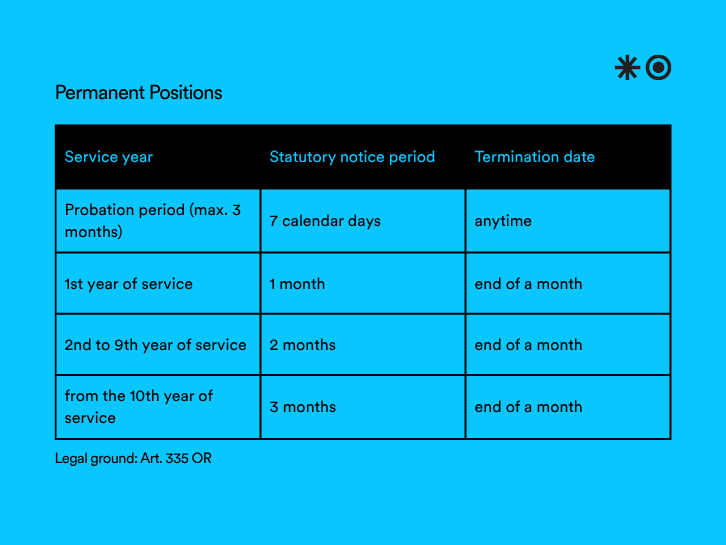
Under Art. 335c of the Swiss Code of Obligations (CO; OR in German), notice periods in Switzerland increase with length of service: 1 month in the first year of service, 2 months from the second to the ninth year, and 3 months from the tenth year onward, in each case to the end of a calendar month. During the probationary period (3 months at most), the notice period is 7 calendar days. Different periods can be agreed by contract, but they must be the same length for employer and employee. Protected periods (Sperrfristen) under Art. 336c CO apply in the event of illness, accident, pregnancy, or military service.
A termination is rarely a routine matter, whether you are the employee or the employer. Anyone who wants to end an employment relationship correctly in Switzerland needs a firm grasp of notice periods, termination dates, formal requirements, and special cases such as illness or pregnancy. This guide summarizes the legal position in 2026, walks through worked examples, provides a template letter, and explains what is different in staff leasing and temporary work.
Overview: notice periods for permanent positions
Once the probationary period is over, the notice period depends on the number of years of service. The following periods are the statutory minimum and can be extended in the employment contract, a collective bargaining agreement (GAV), or a standard employment contract (NAV), but only on the same terms for both parties (Art. 335a CO).
Important: for permanent positions, “end of a month” means that the notice period ends on the last calendar day of a month, not 30 days later. With a 1-month notice period, notice delivered on June 13 therefore runs until July 31.
Overview: notice periods in staff leasing
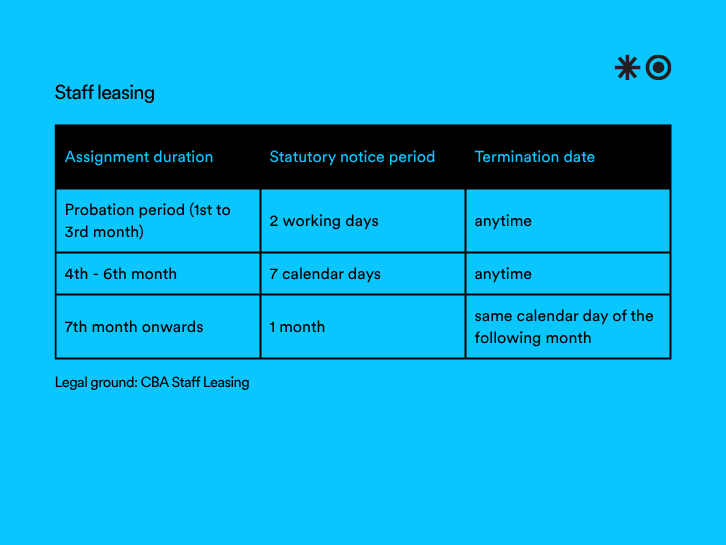
In staff leasing, the notice period depends on the length of the assignment and follows the CBA Staff Leasing (GAV Personalverleih), not the Code of Obligations.
Important: unlike permanent positions, there is no termination date at the end of the month. Notice can be given at any time. From the seventh month of the assignment, the notice period ends on the same calendar day of the following month. With a 1-month notice period, notice given on June 15 therefore runs until July 15.
Notice period during probation
By law, the probationary period lasts one month, but it can be extended to a maximum of three months in the employment contract, a collective bargaining agreement (GAV), or a standard employment contract (NAV) (Art. 335b CO). If the probationary period is effectively cut short by illness, accident, or the fulfillment of a legal obligation not taken on voluntarily, it is extended accordingly and can therefore last longer than three months. During the probationary period, the notice period is 7 calendar days, not working days. Notice can be given on any day, and the end date does not have to fall at the end of a week or a month.
Example: probation
You receive notice on Tuesday, June 16. Notice period: 7 calendar days. The employment relationship ends on Tuesday, June 23. Your actual last working day may differ. It makes no difference whether a weekend falls in between.
The protected periods for illness, accident, or pregnancy do not apply during probation. Anyone who falls ill during the probationary period can therefore be given notice. Staff leasing (temporary work) has its own rule: in the first three months, the notice period is only 2 working days.
Calculating the notice period and termination date: when does the notice have to arrive?
Notice of termination is a declaration that has to reach the other party. It only takes legal effect once the recipient has received it, not when it is sent. The postmark does not count. What matters is the day on which the recipient actually receives the notice (for registered mail, the first day on which it can be collected from the post office). You can find more on this in the SECO FAQ on termination (in German).
Example A – Resigning in the first year of service
You hand in your notice on June 13, 2026.
Notice period: 1 month to the end of the month.
→ Last working day: July 31, 2026.
Example B – Late delivery can be costly
You drop your notice into your employer’s mailbox at 7:30 p.m. on May 31. As nobody is left in the office, it is not deemed delivered until June 1. With a 2-month notice period, the employment relationship now ends on August 31 instead of July 31.
→ One day late = one month longer.
Practical tip
Either hand over your notice in person against a signature or send it by registered mail several days before the end of the month. That way, you have proof of delivery.
Termination in special cases: illness, pregnancy, military service
The Code of Obligations protects employees from termination in certain life situations. During these protected periods, the employer is not allowed to give notice (Art. 336c CO). If notice is given anyway, it is void. If notice was given before the protected period began, the notice period is suspended for the duration of the protected period and resumes afterward.
Protected periods for illness and accident through no fault of the employee (Art. 336c para. 1 let. b CO)
1st year of service: 30 days
2nd to 5th year of service: 90 days
From the 6th year of service: 180 days
Other protected periods
- Pregnancy and the 16 weeks after the birth
- Swiss military service, civil protection service, or civilian service (during the service and, if it lasts more than 11 days, for the 4 weeks before and after)
- Taking part in an aid operation abroad ordered by the authorities
Important: Employees may still resign during a protected period. The protection only applies to notice given by the employer.
Termination with immediate effect: when is it permitted?
Termination with immediate effect (Art. 337 CO) ends the employment relationship at once, without any notice period. It is only permitted for “good cause”: conduct that means the party giving notice cannot in good faith be expected to continue the employment relationship. Notice must also be given without delay, which in practice means within 2 to 3 working days of learning of the reason. For details, see the SECO FAQ on termination with immediate effect (in German).
Typical grounds for termination with immediate effect
- Theft, fraud, or a serious breach of trust
- Persistent refusal to work despite a warning
- Physical assault, serious insults, or sexual harassment
- Repeated and serious breaches of the duty of care
- Unpaid salary over several months (grounds for the employee to terminate with immediate effect)
Unjustified termination with immediate effect can be costly: the employee is entitled to what they would have earned up to the regular end of the contract, plus compensation of up to six months’ salary (Art. 337c CO). Be aware: anyone dismissed with immediate effect also risks a suspension of unemployment insurance benefits (Einstelltage).
Protection against dismissal and wrongful termination
In principle, Switzerland applies freedom of termination: either party may end the employment relationship at any time, provided the notice period is observed. Reasons only have to be given in writing on request (Art. 335 para. 2 CO). There are, however, two important limits:
- Protected periods (Art. 336c CO) – see the section above.
- Wrongful termination (Art. 336 CO) – for example on grounds of age, gender, religion, or union membership, or because the employee asserted claims under the employment contract or blew the whistle.
Anyone who believes their termination is wrongful must object in writing before the notice period expires and file a claim within 180 days of the end of the contract. Compensation is capped at six months’ salary (Art. 336a CO).
The myth of “protection against dismissal from age 50”
Switzerland has no automatic protection against dismissal for older employees. In several rulings, however, the Federal Supreme Court has held that employers owe a heightened duty of care to older employees with many years of service. Before giving notice, this can include hearing the employee, offering a chance to improve, and looking for alternatives within the company.
Termination letter: template and checklist
In principle, notice can be given verbally. In practice, giving it in writing is strongly recommended, and many employment contracts require it. That way, you secure proof and a date. You only have to give reasons on request.
Checklist before you send
- Correct date and addressee (HR department or line manager, as specified in the contract)
- Double-check the calculation: years of service, notice period, end of month
- Handwritten signature
- Send by registered mail or hand over in person against confirmation of receipt
- A copy for your own records
Termination agreement: an alternative to giving notice
A termination agreement (Aufhebungsvertrag) ends the employment relationship by mutual consent, without the regular notice periods and without protected periods. However, an agreement of this kind must rest on a genuine balancing of both parties’ interests and must not circumvent mandatory protective provisions to one party’s disadvantage. It is commonly used for amicable separations, restructurings, or a move to a new job with a different start date.
What a termination agreement should cover
- Leaving date and last working day
- Garden leave (paid / unpaid) and offsetting of remaining vacation days
- Final payment, bonus, overtime, commissions
- Non-compete clause, confidentiality, return of company property
- Reference letter (ideally with a draft attached)
- Full and final settlement clause – caution: this means “all mutual claims have been settled”
The unemployment insurance trap: Anyone who signs a termination agreement without a new job lined up risks a suspension of benefits from the unemployment insurance fund. Be sure to check with your regional employment center (RAV) first.
Garden leave and outstanding entitlements during the notice period
Garden leave means that the employee is released from the obligation to work, while the employment relationship continues until its official end date. Salary remains payable. The following points are usually agreed:
- Offsetting of remaining vacation days and any overtime
- Offsetting of interim earnings from a new job
- Non-compete clause and return of work equipment (laptop, keys, vehicle)
- Informing clients and handing over ongoing projects
Further information for employees and employers: ch.ch – Termination or dismissal.
Staff leasing and temporary work: what is different?
In staff leasing, some notice periods differ from those in a standard employment relationship. They are based on the CBA Staff Leasing (GAV Personalverleih) 2024–2027 and the Federal Act on Recruitment and the Hiring of Services (AVG).
In the first three months of an open-ended employment relationship in staff leasing, the notice period is only two working days. From the fourth to the sixth month, it is seven calendar days. From the seventh month, it is one month. In that case, notice can be given at any time and the notice period ends on the same day of the following month, not at the end of a month as in a standard employment relationship.
For fixed-term assignment contracts, the first step is to check whether a right of ordinary termination was agreed at all.
Our experience from daily business at Coopers
As a staffing provider, we guide companies and employees through new starts, changes of assignment, and departures every day. Common pitfalls: notice not properly delivered by the end of the month, overlooked protected periods during illness, and confusing the notice periods of the CBA Staff Leasing with those of the Code of Obligations. If you have questions about assignments or the end of a contract, our consultants will be glad to help.
If you have any questions about assignments or contract termination, our specialists will be happy to assist you.

Contact us
Get in touch privately and with no obligation to arrange a chat with Lukas.
Lukas Limacher
+41 44 485 44 87
lukas.limacher@coopers.ch
FREQUENTLY ASKED QUESTIONS ABOUT NOTICE PERIODS IN SWITZERLAND
Exactly the same periods apply as when the employer gives notice: 1 month in the first year of service, 2 months from the second to the ninth year, and 3 months from the tenth year onward, in each case to the end of a month. During probation, it is 7 days.
Yes. In principle, freedom of termination applies (Art. 335 CO). The notice only has to meet the formal requirements (usually in writing) and observe the notice period. Reasons only have to be given in writing on request
From the tenth year of service with the same employer, unless the contract or collective bargaining agreement provides for a longer period. For management positions, it is common for contracts to extend the notice period to 3 or 6 months.
Once the probationary period is over, a protected period applies: 30 days (1st year of service), 90 days (2nd to 5th year), or 180 days (from the 6th year). Notice given during this time is void. A notice period that is already running is interrupted and resumes after the illness.
Not quite “immediately”: a notice period of 7 calendar days applies, and it can start on any day. In staff leasing, this is reduced to 2 working days in the first three months.
In writing, dated, and signed, with a clear statement of the termination date and with proof of delivery. Ideally, hand it over in person against confirmation of receipt or send it by registered mail. Allow enough time for the notice to arrive before the last day of the month.
Only for good cause (Art. 337 CO) that makes it unreasonable to continue the employment relationship, such as theft, physical assault, or a serious refusal to work despite a warning. Notice must be given without delay once the reason is known.
Your salary up to the regular end of the contract, plus compensation set by the court of up to six months’ salary (Art. 337c CO). You may also be entitled to damages.
No. What matters is the moment at which the notice reaches the other party’s sphere of control. For registered mail, this is the first day on which it can be collected.
Not across the board. Case law does, however, require employers to exercise a heightened duty of care toward older employees with many years of service: hearing the employee, looking for alternatives, and finding fair transitional arrangements before giving notice.
Sources and further information
This guide is based on the following official and recognized sources:
- Fedlex – Swiss Code of Obligations (CO)
- SECO – FAQ on termination (private employment law, in German)
- SECO – FAQ on termination with immediate effect (in German)
- SECO – Fact sheet “Termination and protection against dismissal” (PDF, in German)
- ch.ch – Termination or dismissal in Switzerland
- swissstaffing – CBA Staff Leasing (GAV Personalverleih) 2024–2027 (in German)
Legal notice
This article is for general information and is not a substitute for legal advice. In individual cases, particularly disputes, termination with immediate effect, or complex situations involving protected periods, we recommend consulting the cantonal conciliation authority or a lawyer specializing in employment law.
You can download our employee termination letter template for free here:
Career

Networking Challenges? Not With These Tips
The biggest networking hurdle: meaningless small talk. Our tips will change that.

Coopers Competence Compass
A trend snapshot on professional development: Which skills matter most in 2026 and how companies as well as professionals can take action now.

Mindset matters: Why Your Way of Thinking Determines Success
Find out here why the growth mindset is the key to long-term success.

Reskilling
New roles are emerging. Reskilling is the key to preparing people and companies for the future. Why now is the time to rethink and how Coopers recognizes potential before it is visible on CVs.


_1.svg)