The 4 R’s of 2026
Future Trends in Regulatory Affairs: A Conversation with Martin King on Reliance, Realignment, Rationalisation, and Resilience

from Dr. Elena D’Cruz
08. July 2026
_0.jpg?m=1782722281 "Ein Gespräch mit Martin King zu den 4 R's von 2026: Reliance, Realignment, Rationalisation, Resilience")
Martin King Martin King has spent decades navigating the intersection of engineering, quality, and regulatory affairs across medtech, and pharma. At the Coopers Life Sciences Circle, he laid out a framework for where the industry stands in 2026 and where it needs to go. We sat down with him to dig deeper.
Note: A live presentation relies on tone and delivery; however, the written word requires precise boundaries, especially in a highly regulated industry like Life Sciences. That is why Martin King has expanded his answers in this interview to include explicit regulatory positions. The italicized sections "What this means in practice" are designed to offer genuine value and direct guidance for Life Sciences professionals in their day-to-day operations.
Coopers: You opened your session with what you called the "Four R's of 2026." Can you walk us through them?
Martin King (MK): When I do my weekly regulatory roundup, I look at what's happening across the world: pharma, medtech, every major market. And when I looked back at 2025 and forward into 2026, four themes kept coming up everywhere. Resilience, Reliance, Realignment, and Rationalisation. They are not isolated trends. They are interconnected, and they apply whether you are in Switzerland, the US, or anywhere else in the world.
What reliance really means and where it gets dangerous
Coopers: Let's start with reliance. There's been a lot of discussion about regulatory convergence. The idea that approvals in one market could be accepted in another. You were critical of that.
MK: Very. There is an idea gaining traction here in Switzerland that SwissMedic might simply accept devices that have already been approved by the FDA. And on the surface, that sounds efficient. But I can tell you from direct experience: there are devices I have gotten through the FDA that I would never want on the market in Europe. The standards are different. The risk tolerances are different. Reliance sounds great until it is not. It is a dangerous oversimplification.
What this means in practice: Regulatory reliance must never be blindly assumed, as frameworks like the FDA and the EU operate under fundamentally different risk classifications, clinical evidence expectations, and post-market surveillance requirements. Uncritical reliance on foreign approvals risks severe compliance failures during local market access. As a required regulatory control, a documented gap assessment against local requirements must be performed prior to leveraging any external approvals.
Realignment: Why MDR was no mistake
Coopers: The second R is realignment, which you connected to the MDR and IVDR, the EU Medical Device Regulation and the EU In Vitro Diagnostic Medical Device Regulation
MK: The frustration with MDR and IVDR is understandable, but people tend to focus on the negatives. Here is the thing: we went over 20 years without a meaningful regulatory change in Europe. It is no surprise that a whole generation of professionals struggled when a new regulation finally arrived? They had never been tested on it. They had never had to read, understand, and apply something fundamentally new.
And when you go 20 years between revisions and then produce something as thorough and detailed as MDR, it is not going to be perfect first time. That is what realignment is about – the tuning that inevitably follows. We are seeing that now, including a motion to revise Annex 7, which governs how Notified Bodies have to behave.
What this means in practice: Major regulatory reforms inevitably trigger a post-implementation phase of adjustment (realignment). Because extended transitional periods increase the risk of ambiguity and inconsistent application by both Notified Bodies and manufacturers, proactive action is mandatory. Companies must maintain continuous regulatory intelligence and implement structured impact assessments for all emerging guidance, revisions, and corrigenda.
Coopers: You were quite pointed about Notified Bodies specifically.
MK: Because the situation is genuinely inconsistent. Notified Bodies are supposed to be uniform across the EU – same standards, same judgment criteria. But they are appointed by individual member states. So is it a surprise that they don't all operate identically? Of course it is not. Annex 7 governs their quality management systems, and I can tell you, a Notified Body's QMS looks very different to the QMS of a medical device company or a GMP pharma company. The revision is necessary. It is overdue.
What this means in practice: Notified Body variability is an operational reality within the EU system, as designation and oversight occur at the individual Member State level. Assuming uniform assessment criteria creates a significant risk of unexpected non-conformities during conformity assessments. It is essential to define and document a specific Notified Body engagement strategy to align expectations and interpretations early on.
Rationalisation: Less is more
Coopers: The third R is rationalisation, what does that mean in practice?
MK: Streamlining. Reducing duplication and inconsistency in how compliance is managed. A lot of companies have accumulated five, six, seven different tools – an eQMS, something for change tracking, something for regulatory intelligence, something else entirely – and none of them are properly connected. Regulators are increasingly looking for continuity. They want to see a system, not a collection of documents. Rationalisation is about building that integrated picture, not just having individual pieces that look good in isolation. How this looks in practice has been described in detail by Matthias Pohl.
What this means in practice: Regulators increasingly assess data integrity, continuity, and the logical linkage between processes rather than reviewing isolated documentation artifacts. Disjointed, incompatible systems drastically increase the likelihood of inconsistent records and audit findings. The solution lies in implementing an integrated Quality Management System architecture with defined data flows, clear ownership, and connected change control mechanisms.
Resilience: Putting an end to the patchwork
Coopers: That leads into your central argument about Resilience. You say "readiness is gone." What do you mean?
MK: Readiness, as most companies still practice it, is a momentary thing. You get word of an audit coming, everyone panics, you patch the road, make everything look perfect – and the moment the auditor leaves, you go back to the unpaved version. That is expensive, it is stressful, and frankly, it misses the point entirely.
Regulators are not looking for a short stretch of perfection. They are looking for a company that operates safely and effectively every single day – not just when someone is watching. And the FDA and SwissMedic both reserve the right to conduct unannounced inspections. If you are building toward resilience, an unannounced visit is not a crisis. It is just Tuesday.
What this means in practice: Point-in-time audit readiness is entirely insufficient under modern regulatory inspection models. Since authorities like the FDA and Swissmedic perform unannounced inspections, reactive compliance models inevitably allow systemic gaps to become visible during an audit. Companies must operate in a continuous state of control supported by live QMS data, routine internal verification, and proactive risk management.
Coopers: Why is resilience not already the norm?
MK: Culture. For generations, the mindset has been: submit, get approved, maintain compliance just enough to pass the next audit. The QMS became something you manage for the auditor, not for yourself.
I see this with risk management too. Most companies build a risk table because the standard requires one. I go in and ask, "How is this useful?" And the answer is "we need it for the auditor." That is completely wrong. A risk-based system should tell you, in real time, if you change something here, what it impacts over there. I have built full risk analyses mapping every line of a standard against every SOP and work instruction – so you can trace the impact of any single change across the entire system. Not many companies do this. But that is what risk-based assessment actually means. It is about having control of your own destiny, not making the auditor happy.
What this means in practice: Risk management systems must serve as operational decision tools throughout the product lifecycle, rather than remaining static documentation artifacts created solely for audits. Without dynamic risk traceability, the downstream impacts of changes go unnoticed. It is critical to establish dynamic risk pathways that directly link standards, procedures, and operational activities.
AI: Great Potential, but Also Great Risks
Coopers: Where does AI fit into all of this?
MK: AI is a genuinely useful tool but it is being misunderstood on both ends. People either think it is going to replace regulatory professionals, or they dismiss it as glorified Google. Neither is right.
If you move beyond simple prompting and build proper agents – with version control, product-specific configuration, and what I would call AI skills packs, which are essentially governance layers that constrain how the tool behaves – you can generate documentation from your data almost automatically. That is powerful. But you have to do the change control. You have to maintain it like any other system in your QMS.
And there is something people need to understand about how these tools actually work. Large language models are probabilistic. They predict the most likely sequence of words based on what they have seen. AI is a lottery – a very sophisticated lottery, but a lottery. The FDA deployed an AI-assisted review tool and it reportedly asked a company for documents from a clinical trial that did not exist. Hallucination is real. That is not an argument against AI, but it is an argument for keeping expert judgment in the loop at all times.
What this means in practice: AI systems must never act as autonomous decision-makers in a regulated environment; instead, they must be governed as controlled tools within the QMS. Because LLMs are probabilistic and prone to generating inaccurate information ("hallucinations"), unvalidated outputs pose massive risks to data integrity. Required controls include a clearly defined intended use, mandatory human verification (human-in-the-loop), and strict version and change control applied to all AI-enabled processes.
Coopers: You expressed concern about the next generation of professionals becoming too dependent on these tools.
MK: It takes three to five years minimum to become genuinely proficient in a regulatory niche. I do not think that changes. What worries me is that those five years will produce professionals with less real depth, because they will have relied on tools instead of developing judgment. Maybe the tools improve fast enough to compensate – maybe the whole thing balances out. But we should be very deliberate about this with trainees. AI skills are about configuring the machine. Human expertise is about knowing when the machine is wrong. You need both.
What this means in practice: Competence development for the next generation must carefully balance technological tool proficiency with independent regulatory judgment. Over-reliance on automated tools hinders the development of critical evaluation skills essential for complex regulatory decision-making. Companies must implement structured training programs that explicitly target and develop critical thinking, regulatory interpretation, and tool validation skills.
Conclusion: QMS = Raincoat
Coopers: Your final thought?
MK: Treat your quality management system like your raincoat. You do not put it on when the forecast says rain and take it off the moment you are inside. You maintain it because weather is unpredictable. There is no reason – and no excuse – to operate any other way.
What this means in practice: A Quality Management System (QMS) must function as a continuous control system rather than an episodic compliance mechanism. Because regulatory authorities expect sustained performance, traceability, and demonstrable control, intermittent compliance models increase both inspection risks and operational instability. The QMS must be maintained as an active, continuously monitored system integrated into daily operations.
Thank you very much for your time and your valuable insights, Martin.
Coopers Life Sciences Circle: 22nd October 2026
Conversations like this one are what the Coopers Life Sciences Circle is built for. The CLSC offers Life Sciences professionals an opportunity for exchange in a relaxed atmosphere; the evening in April was rated 4.9 out of 5 by participants.
If you would like to join, the next CLSC takes place on October 22, 2026.
Your can register here, attendance is free of charge.
We look forward to seeing you there.
Your Coopers Family
#ingoodcompany
FAQ on Regulatory Affairs: The 4 R's of 2026
Regulatory Reliance refers to the practice of accepting or leveraging an approval from one market to support registration in another. While it sounds efficient, it is not without risk. Regulatory frameworks differ fundamentally in risk classification, clinical evidence requirements, and post-market surveillance obligations. A device approved by the FDA does not automatically meet EU standards. Before leveraging any external approval, a documented gap assessment against local requirements is mandatory.
Realignment describes the calibration phase that follows major regulatory reform. MDR and IVDR represented the first significant overhaul of EU medical device regulation in over 20 years. The inconsistencies and challenges seen since implementation are not a sign of failure – they are the expected result of transformative change. Companies must maintain continuous regulatory intelligence and perform structured impact assessments for all emerging guidance, revisions, and corrigenda.
Rationalisation means reducing duplication and inconsistency across compliance management. Many companies operate five or more disconnected tools – an eQMS, change tracking software, regulatory intelligence platforms – none of which are properly integrated. Regulators increasingly assess continuity and data integrity across the entire system. The goal is one integrated QMS architecture, not a collection of documents that look good in isolation.
Audit Readiness is a point-in-time state: companies prepare intensively before an inspection and revert to business as usual afterward. Resilience means operating in a continuous state of control every day, regardless of whether an inspection is scheduled. Both the FDA and Swissmedic conduct unannounced inspections. A resilient organization is not disrupted by an unannounced visit, it is simply another working day.
AI can meaningfully accelerate documentation and regulatory intelligence workflows — but only when governed as a controlled system within the QMS. Large language models are probabilistic and can generate inaccurate information, a phenomenon known as hallucination. Required controls include a clearly defined intended use, mandatory human verification, version control, and formal change control applied to all AI-enabled processes. AI supports expert judgment. It does not replace it.
No. Proficiency in a regulatory niche takes a minimum of three to five years to develop and that does not change with AI. What changes is the toolset. AI skills mean knowing how to configure and govern the tool. Human expertise means knowing when the tool is wrong. Both are essential – and training programs must deliberately develop both.
Life Sciences

From Lifecycle Control to System Trust
Interview with Matthias Pohl on data-driven regulation, the FDA's ELSA platform, and what right-first-time really means.
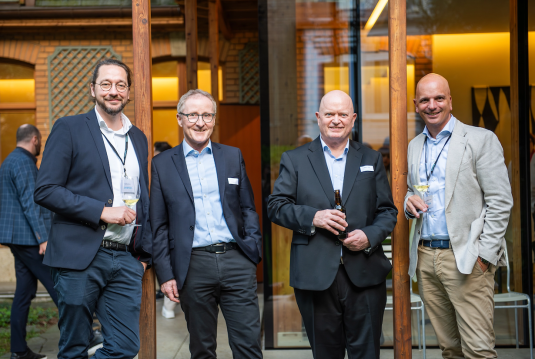
Coopers Life Sciences Circle in April 2026
The Coopers Life Sciences Circle 2026 brought together senior experts in Regulatory Affairs and Pharma Quality for an evening of sharp insights and meaningful exchange.

Coopers Life Sciences Circle 2025
At the first Coopers Life Sciences Circle at the Orangerie Basel, industry experts came together to network.

Coopers at Ironwood Pharmaceuticals
Coopers supports IT roll-out at long-standing client VectivBio following acquisition by Ironwood.


_1.svg)