What UK Companies Need to Know Before Recruiting in Switzerland
5 minutes with Christian Biedermann

from Dr. Elena D’Cruz
12. August 2026
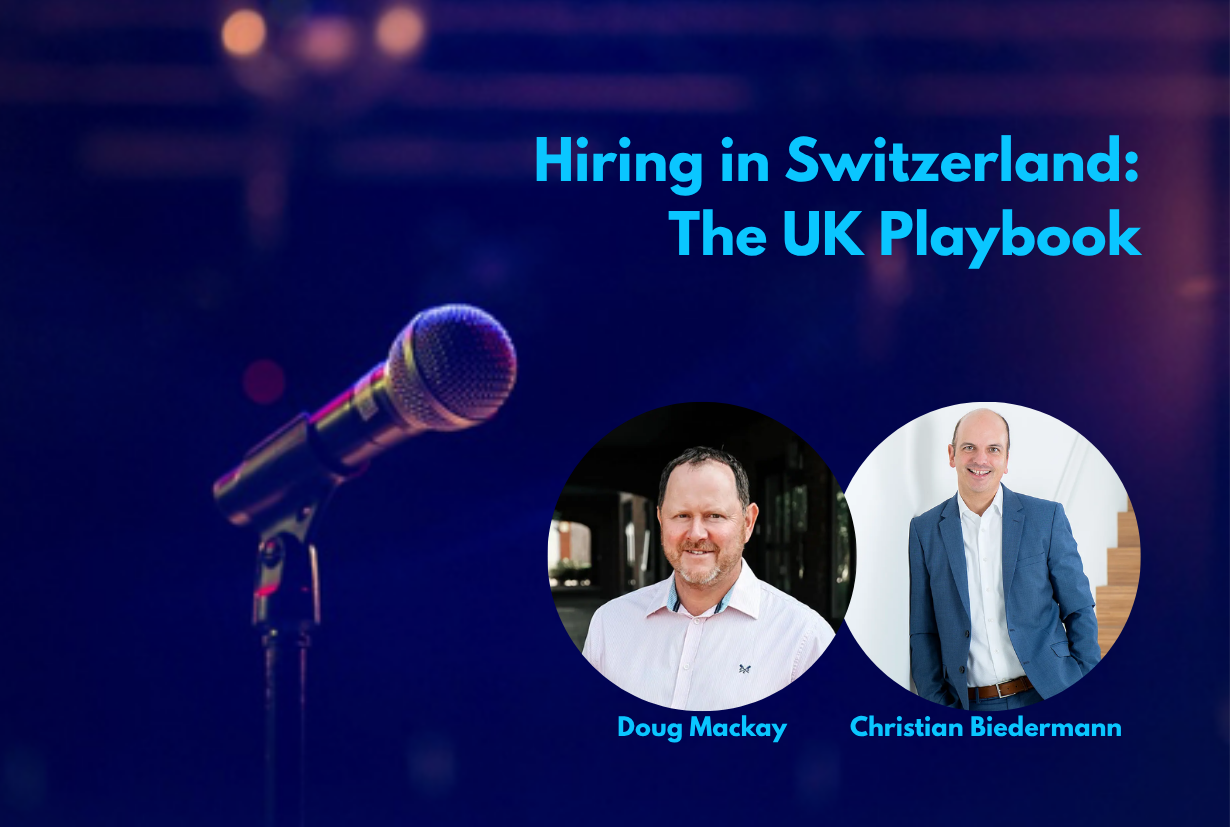
Doug Mackay, Managing Director at Collingwood Executive Search – a partner agency within the Talentor International network – sat down with our Managing Director Christian Biedermann to discuss what makes Switzerland such an attractive, and demanding, market for UK companies.
The original article from Doug was published on LinkedIn in two parts (one & two).
Why Switzerland?
Doug Mackay: Christian, it is great to speak with you. Coopers has been a cornerstone of the Swiss recruitment market since 2010. For UK companies looking at Switzerland as their next expansion target, what makes the market so attractive right now?
Christian Biedermann: It is a pleasure, Doug. Switzerland really does have a unique appeal. Foreign companies appreciate Switzerland's political and economic stability, its strong legal framework, and its position as one of Europe's leading innovation hubs. Combined with an exceptional quality of life and access to highly qualified international talent, Switzerland remains a very attractive destination for international expansion. We offer a highly international environment, which is particularly attractive for companies in sectors like Life Sciences, Information Technology, and Engineering.
However, it is a premium market. Switzerland is one of the most expensive countries in the world, and both the cost of living and salaries reflect that. The administrative infrastructure is incredibly well-organized and supportive for businesses setting up here, but you have to be prepared for the investment required to secure top talent.
The Widest Talent Gap
Doug Mackay: You mentioned Life Sciences and IT. Are these the sectors where you are seeing the most acute talent shortages?
Christian Biedermann: Absolutely. While the Swiss labour market has become somewhat more balanced in recent years, competition for highly qualified specialists remains intense in a number of key sectors. Switzerland continues to benefit from one of the lowest unemployment rates in Europe, and companies are still competing fiercely for individuals with niche expertise, strong leadership capabilities, and international experience.
In the IT sector, demand remains particularly strong for professionals in Cloud, Cyber Security, Data & AI, SAP, and Software Engineering. In Life Sciences, where Switzerland, and particularly the Basel region, is one of the world's leading innovation clusters, we continue to see strong demand for specialists in R&D, Clinical Development, Regulatory Affairs, Manufacturing, and Quality Management.
The healthcare sector is also facing significant talent shortages, particularly for physicians, nursing professionals, and specialised medical experts. In addition, we continue to see shortages in selected Engineering disciplines and senior leadership positions, where the combination of technical expertise, international experience, and cultural fit can be difficult to find. As a result, many Swiss employers increasingly recruit talent internationally to complement the relatively small domestic talent pool. For companies entering the Swiss market, having access to local networks and international talent pools is often a key success factor.
The Cultural Misstep UK Companies Make
Doug Mackay: When UK companies start recruiting in Switzerland, what is the most common cultural misunderstanding they encounter?
Christian Biedermann: It usually comes down to communication style. A very direct, demanding style of communication can really bother Swiss professionals. The Swiss tend to operate on a "need to know" basis. They make requests, not demands.
We are very careful, perhaps even a little reserved, when it comes to communicating. We love nothing more than subjunctives, could, would, and should are our best friends. A Swiss person orders coffee by saying, "I would like to have a coffee, please," whereas others might just say, "I'll get a coffee." We say please and thank you for everything. UK leaders need to adapt to this polite, consensus-driven approach; coming in too aggressively will quickly alienate your Swiss team.
Why Hiring Takes Longer Here, And Why That's The Point
Doug Mackay: How does this consensus-driven culture affect the hiring process itself?
Christian Biedermann: It means the process is often highly collaborative and can take longer than a UK company might expect. Hiring decisions often involve several stakeholders, particularly for leadership and specialist positions. Employers typically place significant emphasis on cultural fit, long-term commitment, and alignment with company values. Candidates expect to meet multiple stakeholders and understand how they fit into the broader team dynamic.
Furthermore, because the market is so candidate-driven, the interview process must be a two-way street. You are not just assessing them; they are assessing your company's stability, culture, and long-term vision. If a UK company tries to rush the process or fails to sell the opportunity effectively, they will lose out to local competitors who understand how to court Swiss talent.
Top Piece of Advice
Doug Mackay: For a UK company making its first senior hire in Switzerland, perhaps a Country Manager, what is your top piece of advice?
Christian Biedermann: Do not underestimate the importance of local market knowledge and established networks. Switzerland may be a relatively small country geographically, but it is highly diverse in terms of language, culture, and business practices.
Your first hire should not only bring the required technical and commercial expertise but also understand how business relationships are built in Switzerland. Trust, reliability, and long-term commitment matter enormously. Companies that invest in these relationships and partner with local experts typically establish themselves far more successfully than those trying to apply a one-size-fits-all international approach.
Getting the Legal Basics Right
Doug Mackay: Christian, let us get into the practicalities. When a UK company is ready to hire in Switzerland, what are the key differences in employment law they need to be aware of?
Christian Biedermann: The Swiss labour market is generally regarded as one of the most flexible and business-friendly in Europe. At the same time, it is built on a strong culture of mutual trust, social partnership, and clearly defined employer responsibilities. Employment is governed by the Code of Obligations, and while a written contract is not strictly mandatory, it is highly recommended.
One major difference is our approach to industrial relations. Strikes are exceedingly rare here because we have a long tradition of avoiding conflict through negotiation. Many sectors are governed by collective bargaining agreements that set out the conditions for employment. Termination is generally more straightforward than in many neighbouring European countries. While employers are not required to demonstrate the same level of justification seen elsewhere, dismissals must still comply with Swiss employment law and cannot be abusive or discriminatory. Respecting notice periods and following a professional process remains essential.
Notice Periods and Probation: What to Plan Around
Doug Mackay: Speaking of notice periods and probation, how do those typically structure in Switzerland?
Christian Biedermann: The standard probation period is one month, though it can be extended up to three months by written agreement. During probation, the notice period is very short, typically just seven days.
After probation, statutory notice periods apply: one month during the first year of service, two months for years two through nine, and three months for ten years or more. However, for executive and senior management roles, it is very common to negotiate longer notice periods, often three to six months from the outset, to ensure business continuity. UK companies need to factor these longer timelines into their succession planning and recruitment cycles.
Compensation: It Is Rarely Just About Salary
Doug Mackay: You mentioned in our previous chat that Switzerland is an expensive market. How should UK companies approach compensation and benefits to remain competitive?
Christian Biedermann: Competitive compensation is important, but attracting talent in Switzerland is rarely just about salary. Senior professionals evaluate the entire package, including pension contributions, flexibility, leadership quality, career opportunities, and the long-term stability of the employer. There is no statutory national minimum wage, but salaries are high across the board.
Beyond the base salary, employers must account for social security contributions, occupational pension plans, accident insurance, and other statutory obligations. Depending on age and salary level, the total employer costs can be significantly higher than many international companies initially anticipate. It is also standard practice in many Swiss companies to pay a "13th-month salary," essentially the annual salary divided by 13, with the extra month paid out in November or December. If you do not offer a competitive pension scheme and understand these structural expectations, you will struggle to attract top-tier talent.
Work Permits After Brexit
Doug Mackay: What about work permits? If a UK company wants to relocate a British executive to Switzerland, how difficult is that post-Brexit?
Christian Biedermann: It has certainly become more complex. Switzerland is not in the EU, but we have bilateral agreements allowing the free movement of persons for EU and EFTA nationals. For them, obtaining a permit is largely an administrative process.
However, post-Brexit, UK nationals are considered "third-country nationals." This means they fall under a strict quota system. To secure a work permit for a UK executive, the employer must prove that the candidate is highly qualified and that no suitable candidate could be found in Switzerland or the EU/EFTA region. While the process is more structured for UK nationals following Brexit, work permits remain achievable for highly qualified executives and specialists. The key is early planning and ensuring the role and candidate profile are aligned with the relevant permit requirements.
The One Mistake That Costs Companies the Most
Doug Mackay: Finally, what is the most common mistake you see foreign companies make when setting up their Swiss operations?
Christian Biedermann: The biggest mistake is assuming that success in one market automatically translates into success in Switzerland.
Switzerland may be geographically small, but it is a highly sophisticated and competitive market. Customers expect reliability, employees expect transparency, and business relationships are built on trust over time. The companies that succeed are those that adapt their leadership approach, invest in local expertise, and take the time to understand regional differences across the country. Switzerland rewards long-term thinking and consistent execution.
My advice is simple: build your Swiss organization around people who understand the local market. The right leadership hire can accelerate your growth by years, while the wrong one can be a very costly learning experience.
Contact us
Looking to expand into Switzerland? Get in touch to talk about your Swiss hiring strategy and our flexible temporary talent solutions.
Christian Biedermann
+41 41 632 43 55
christian.biedermann@coopers.ch
FAQ: Hiring in Switzerland
Political and economic stability, a strong legal framework, and its position as one of Europe's leading innovation hubs. Add to that an exceptional quality of life and access to highly qualified international talent, particularly in Life Sciences, IT, and Engineering.
A too direct, demanding communication style. Swiss business culture is reserved and consensus-driven, requests rather than demands. Coming in too aggressively will quickly alienate a Swiss team.
There is no federal statutory minimum wage. However, several cantons, including Geneva, Neuchâtel, and Basel-Stadt, have introduced their own cantonal minimum wages. In addition, many collective bargaining agreements, such as the CBA Staff Leasing for contracting, set industry-specific minimum wage floors.
A common Swiss practice: the annual salary is divided by 13, with the extra month typically paid out in November or December.
Yes, but the process is more complex. UK nationals are now classified as third-country nationals and fall under a quota system. Employers must prove the candidate is highly qualified and that no suitable candidate was found in Switzerland or the EU/EFTA region.
Social security contributions, occupational pension plans, and accident insurance. Total employer costs are often significantly higher than international companies initially expect.
blog
Mr. Amazing Meets Mr. Angst
Why does digital transformation fail not because of technology, but because of people? Oliver Kahle on trust, generations, and leadership in the age of AI.
_0.jpg?m=1782722281 "Ein Gespräch mit Martin King zu den 4 R's von 2026: Reliance, Realignment, Rationalisation, Resilience")
The 4 R's of 2026
What do reliance, realignment, rationalization, and resilience actually mean for regulatory affairs and quality management? Martin King provides some insight.

Like Coming Home
After 43 years in IT, Roland Hänggi starts a new chapter. He shares insights on retirement, Coopers, and his inspiring work in Ghana.

Procurement Day 2026
The Coopers Procurement Day has established itself as a firm institution in Swiss procurement. In 2026, procurement experts once again gathered in Zurich for professional exchange. Discover the full recap and photo gallery now.


_1.svg)